Growth signals and the aging mind
Philadelphia Anti Aging convenes. Hear both motions.
I expected the brain research to make a case for stimulating a hormone signal. Its opponents have evidence to discuss, too.
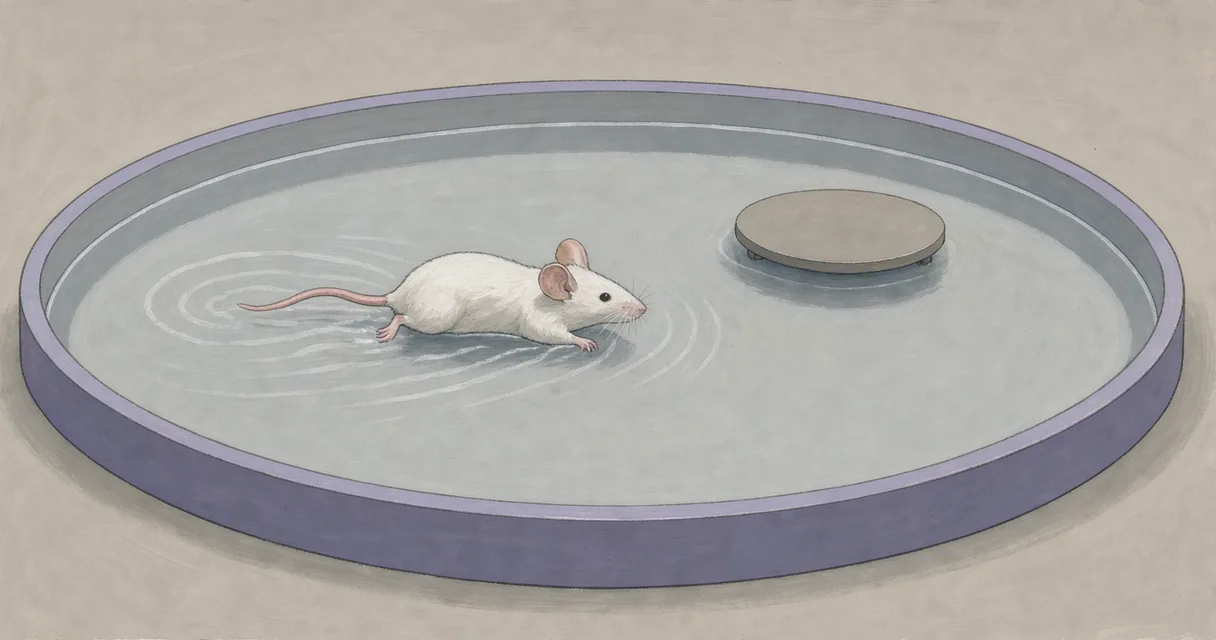
MIA-690 and mouse learning
In an Alzheimer’s-model experiment in mice, MIA-690 improved performance in a water maze. MIA-690 is an antagonist of growth hormone-releasing hormone, or GHRH: it opposes the signal. The mice reached the escape platform sooner; brain amyloid-beta and tau filament levels also fell. In amyloid-beta1-42-treated human HCN2 cortical cell cultures, the study also reported inhibition of the GHRH–GH–IGF-1 axis. An anti-aging story built entirely around turning that axis up would have trouble seating this guest.
That troublesome guest deserves the floor. A city name suggests a public argument to me, with room for an awkward contribution. Philadelphia Anti Aging begins with the aging mind and the possibility that useful findings might arrive from opposing directions.
The water-maze illustration evokes an animal learning experiment. It depicts an imagined apparatus, rather than a scene documented by the paper.
MR-409 in 5xFAD mice
A later experiment used a GHRH agonist, MR-409, in 5xFAD mice and reported better cognitive performance alongside reduced amyloid-beta deposition, tau phosphorylation and gliosis. Systemic GH and IGF-1 stayed unchanged. Gliosis is a response involving the brain’s support cells; its reduction was among the findings in this animal model.
An agonist stimulates a receptor; an antagonist opposes its activity. The GHRH pharmacology review covers both approaches. Cognitive outcomes get my deciding vote; a circulating growth-hormone result receives a supporting role. The experiments make the underlying biology more interesting than a simple contest between more and less.
Tesamorelin and human cognition
The human finding deserves a full hearing. A randomized, double-blind, placebo-controlled trial in older adults found a favorable effect on cognition with tesamorelin, a GHRH analogue. That moves the discussion into people, with an actual cognitive outcome to consider.
My interest in anti aging starts with the ability to think and take part. A convincing cognitive improvement would have my support. The trial earns credit for its finding; its reach into ordinary life still seems unsettled to me. The compound tested was tesamorelin; borrowing the result for sermorelin would change the subject.
Examine the cognition trial, or follow the dissent from a small brain-imaging study.
Glucose tolerance; blood lipids
The cognitive question has to share the room with metabolism. In a study of a long-acting PEG-conjugated GHRH compound, some impairment of glucose tolerance appeared in elderly subjects with repeated exposure. A different GHRH-analogue study in age-advanced men and women reported a temporary rise in blood lipids.
Neither finding tells me to dismiss the brain research. Both affect the bargain I would ask of a future cognitive intervention. An easier mental task would be welcome; the accompanying metabolic findings deserve equal time.